| FEATURES
INTRODUCTION - FORGERY OR FLATTERY?
Ian Hyne examines the pros and cons of building replicas and asks whether the industry enhances or detracts from the reputation of the original cars.
RAW DEAL - TESTING TIMES
Rob Hawkins shows you how the pre-registration Single Vehicle Approval (SVA) test works in practice. Using a RAW Striker as his example.
ABOUT US
Den Tanner reckons we’re people who know what we’re talking about – but he would: wouldn’t he?
BE PREPARED
The decision to build a replica generates excitement, as it should do but there are a few practical aspects to consider that will make the project flow far more smoothly.
BUDGETING FOR A REPLICA BUILD
An early consideration is how much the project is going to cost. You may not build a top show car but Nigel Dean’s check-list covers everything you need to consider.
NOSTALGIA IS A GREAT DEAL BETTER THAN IT USED TO BE
The kit car industry has come a very long way in the last twenty years. Along the way there have been many no-hopers as well as worthy cars that never made it.
A KIWI IN KENT
The MG TF has been a popular replica target but none has really delivered sports performance. The MX5 based TG puts that right as Ian Hyne discovers.
ARC WELDING
Fancy having a go at welding? Plenty of people have built their own Locost chassis using Ron Champion’s book as a guide. Here we give advice on buying the key piece of equipment, a MIG welder.
TOP CAT
The Autotune Aristocat comes under the spotlight once again. The fact that it’s more than 20 years old and bears testament to the fact that there will always be a market for kits that make room for builder ingenuity, originality and individuality.
HANDS ACROSS THE SEA
For replica manufacturers, the Daytona is a natural progression from the legendary Cobra – not as well known but certainly every bit as venomous. We interview Ian Briggs of British American Daytonas.
I COULD DO WITH A ‘D’ - Pt1
We tell the story of a man who loved the D Type Jaguar so much that he simply had to build one. As is often the case for kit car builders, it cost him more than he thought; and in more ways than he anticipated too.
I COULD DO WITH A ‘D’ PART 2 & 3
Peter Marsh completes his bitsa D Type and confesses that he’s bored. He likes C Types too but would need another garage. However, the land is there, but first there’s the thrill of driving this car.
CLASSIC MOTOR SHOW
Certain manufacturers within the kit car industry occasionally break ranks and join the mainstream motoring circus. One such testing of the water was at the recent Classic Motor Show held at the NEC, Birmingham. Nigel Dean checks up on them.
A DASH OF CLASS
If you’ve wondered how to make a quality finished walnut dashboard for your reproduction classic, at a price you can afford, then look no further. The kit car industry is full of companies like Veneer Restoration who can do all manner of complex jobs for you.
FULL CIRCLE
The DNA 360 is one of two Toyota MR2 Mk3 based replicas to follow up the kit-form success of the 355 copies. Ian Hyne has a close look.
ETB
Nigel Dean compares digital instrumentation with conventional analogue instruments in respect of cost and efficiency.
FOREARMED IS FOREWARNED
The Foreman Can Am lurks quietly in the background but is still available to those who care to seek it out. In fact the project is up for sale. Any budding replica makers out there?
LOLA LOVE AFFAIR
Nigel Dean gets to grips with GD’s awesome Lola T70 replica that bases 60s looks on a bang up to date mechanical mix.
STERLING SERVICE
Hallmark Cars is among the top names in used kit cars. Ian Hyne pays them a visit and finds a thriving company with a great deal to commend it.
NO. 59
Hawk Cars is the sole manufacturer of the 289 Cobra and this 289 FIA replica shows the superb authenticity that can be achieved.
IMAGE F27
The Formula 27 that started life as the first of the worthwhile plan-form projects and which later pioneered today’s bike-engined craze, has a new home with Image Sports Cars as Ian Hyne reports.
BY THE BOOK
Ron Champion’s book and the resulting Locost car have swept through the kit car world igniting a fire of enthusiasm that shows no sign of damping down. It’s been gathering pace since Kit Car reported on the prototype car way back in June 1994 and now spans the globe from Australia to America. Ian Hyne catches up with developments.
TIME MACHINE
SOME people say that producing a replica, rather than an original design, is taking the easy route. But to be successful, the modern replica has to comply with SVA regulations, sympathetically incorporate modern donor parts - and still conjure up something of the original’s appeal. No easy task. But it can be done and the Nostalgia XK120 and 140 replicas are living proof.
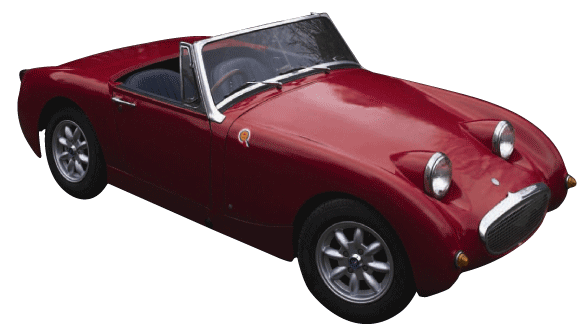
THE EYES HAVE IT
The Tifosi Rana is an old style Frogeyed Sprite replica on a very dated donor but it’s cute, affordable and above all, fun.
GOING LARGE
Ian Hyne tries a Dodge Viper replica for sale at Hallmark Cars. It may not be the best there is but it represents a great candidate for mechanical and interior upgrading.
WIRED AND WONDERFUL
Wire Wheels are essential wear for many 60s and 70s sports car replicas plus a great many of the kit industry’s period roadsters. Wire wheels are a great deal more than a very pretty face - Iain Ayre checks out what MWS have to offer Kit Car readers and finds a few surprises.
KIT CARS GALORE
Summer weather is bringing kit cars out of the garage and into the market-place to make way for new build projects. This month sees the largest selection of complete used kit cars offered for sale. There’s well over 120 at the back of this issue – which is far more than you’ll find anywhere else!
|